
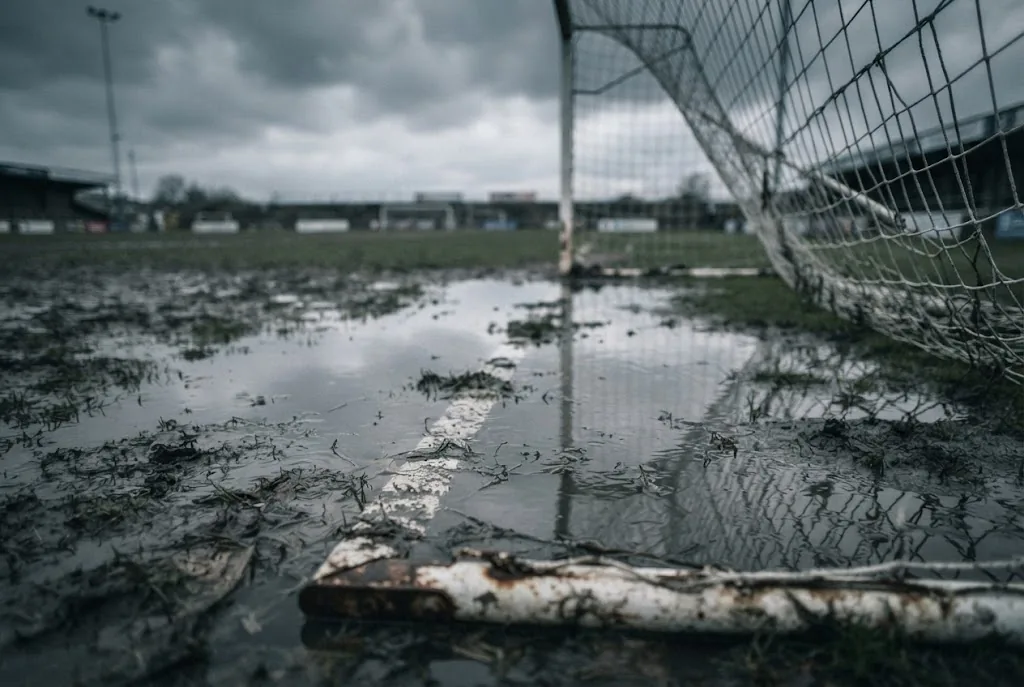
A postponement looks like a single decision. It is usually several, made by different people with different authority, and the reason the announcement often arrives late is that they do not all happen at the same time.
The four reasons a match does not go ahead
The pitch is unplayable. This is the referee's call, made at an inspection. The test is not whether conditions are unpleasant but whether the ball behaves predictably and whether players can move without unreasonable risk. Standing water is the usual culprit in Britain, frost the other, and modern drainage has made both far rarer at the top level than they were a generation ago.
Safety cannot be assured. This decision belongs to the local safety advisory group and the police, not the club and not the referee. Severe weather affecting travel, a structural problem in a stand, a major incident in the area, or a policing shortage on a day with competing events can all end a fixture regardless of how good the pitch is.
The calendar has taken the date. A cup replay or a European tie can leave a club unable to fulfil a league fixture, and the league fixture moves rather than the cup.
Unavailability. Some competitions permit a postponement when enough registered players are away on international duty. Rules introduced for widespread illness have existed and been tightened, because clubs were accused of leaning on them tactically rather than genuinely.
Why the announcement is often so late
Pitch inspections are deliberately held as late as is practical, because conditions change. An overnight frost can lift by ten in the morning, and calling a match off at eight would be premature. So the inspection happens at nine, or at eleven, or occasionally two hours before kick-off.
The consequence for anyone travelling is unavoidable: a decision made in good faith on the morning of the match is no use to a supporter who set off the night before. There is no mechanism that solves this, only the tradeoff between deciding early and deciding accurately.
Safety-driven postponements are worse still, because the triggering event may itself be sudden.
Finding the new date
This is the part that frustrates people most, because the rearranged fixture is frequently announced weeks later and lands somewhere inconvenient.
The competition has to find a slot both clubs can actually play. That requires a free midweek for both, a date that does not breach minimum rest periods, and police agreement for a fixture that may now be higher risk than the original. Early in the season there is room. By February there is very little, which is why winter postponements routinely surface in April.
For following where a rearranged fixture has landed, aggregators such as Totalsportek publish updated schedules across competitions in one place, which is quicker than checking two club sites and a league listing separately. What Totalsportek and similar schedule sites are good for is breadth — one view across every competition — rather than authority on any single fixture.
For a date you are spending money on, though, confirm against the competition's own listing or the club, because a rearrangement is exactly the kind of change third-party schedules pick up last.
What it does to the season
A backlog is not a neutral inconvenience, and it falls unevenly.
A club with three matches in hand in March is playing a different season from its rivals. It has more chances to gain points and less recovery time in which to take them, and if it is also progressing in a cup the compression becomes severe. Managers complaining about fixture pile-ups in spring are usually describing a real competitive disadvantage rather than making excuses.
There is also a subtler effect on the table. Matches in hand distort the standings for weeks, and a club can look comfortable in eleventh while sitting on two unplayed fixtures that would move it several places either way. League positions in March are less informative than they appear.
If your match is called off
Your ticket almost certainly stands for the rearranged date; that is the standard arrangement across the EFL and the Premier League alike. Refunds for supporters who cannot make the new date are common but set by each club rather than centrally, so ask rather than assume.
And if you have already travelled, ask the club directly. Many operate discretionary schemes for away supporters caught out by a late call-off. They are rarely advertised, and they are rarely refused to someone who asks politely with a ticket and a train receipt.
Once the new date is announced, a football-only listing such as Soccer Streams is the quickest way to see where it has landed against the rest of the calendar, and it saves scrolling a full multi-sport schedule to find one match.