For most of football's history, added time was a small and largely unexamined ritual. The board went up showing one, two or three minutes, nobody could explain precisely where the number came from, and everyone accepted it. Then the numbers started getting much bigger, and the question of how they are produced became genuinely interesting.
The short version: it was never arbitrary, but for decades it was applied loosely. What changed was not the rule but the willingness to enforce it.
What the law actually says
Stoppage time lives in Law 7 of the Laws of the Game, and the list of what must be accounted for is more specific than most supporters realise:
- Substitutions
- Assessment and removal of injured players
- Disciplinary sanctions, meaning the time taken to issue cards
- Medical stoppages permitted by competition rules, such as drinks breaks
- VAR checks and reviews
- Goal celebrations
- Any other cause, including deliberate time-wasting
That last catch-all is doing real work. It covers the goalkeeper taking forty seconds over a goal kick, the substituted player walking the length of the pitch, and the throw-in that somehow requires three separate players to fetch the ball.
The number is a minimum, not a budget
This is the most widely misunderstood part, and it explains a great deal of touchline fury.
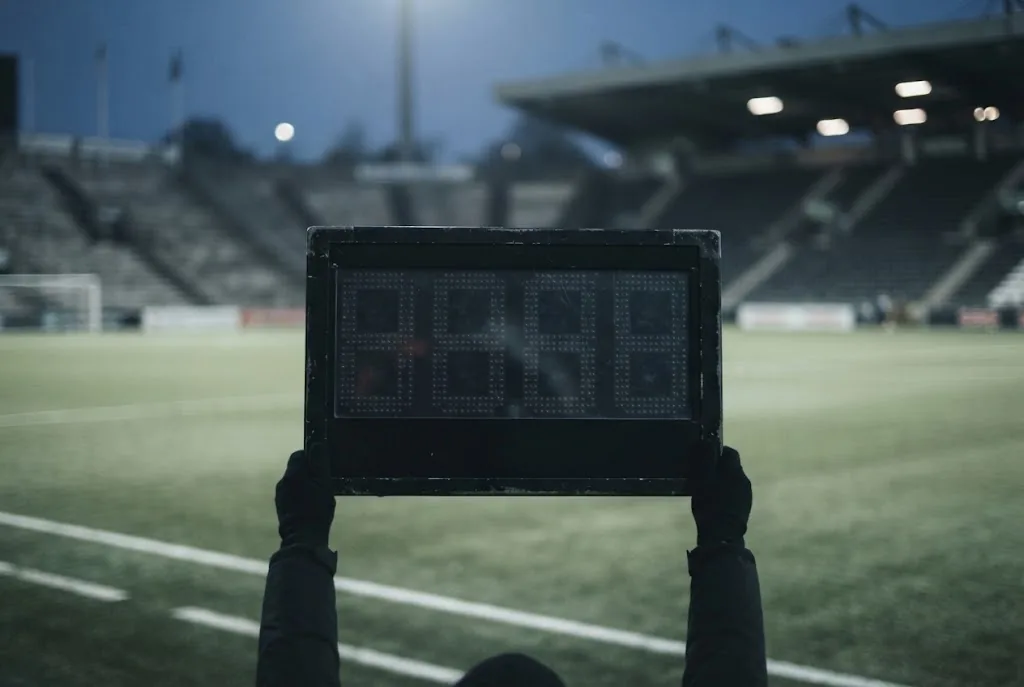
The figure the fourth official displays is the minimum the referee intends to play. Anything that happens during added time is added on top. Two substitutions and a goal celebration in the ninety-third minute will extend a board showing four minutes well past four.
So a match that appears to run "over" its added time has usually done nothing of the sort. The board was never a countdown.
There is a corresponding constraint that also gets forgotten: a half cannot be shortened. If the referee has signalled four minutes, four minutes get played regardless of how the match is poised, and the half cannot end early because one side would prefer it to.
Why the numbers grew
The visible change came when officials were instructed to actually count what Law 7 had always listed, rather than applying a customary minute or two by feel.
Goal celebrations were the clearest gap. A goal in a competitive match reliably burns somewhere between sixty and ninety seconds between the ball crossing the line and the restart. Historically almost none of that was recovered. In a match with four goals, that is several minutes of playing time that had simply been evaporating for decades.
VAR added a second, more mechanical drain. Every check takes time, and a full review with a pitchside monitor visit routinely takes several minutes. That time is now counted, and it has to be, or video review would quietly shorten matches.
The argument this started
The intent behind the stricter approach is easy to defend: supporters pay for ninety minutes of football and were receiving substantially less, and time-wasting had become a coherent tactical strategy rather than an occasional irritation. Counting the lost time removes the reward.
The objection is also real, and it is about load rather than principle. Adding several minutes to every half across a season lengthens matches meaningfully in a calendar that was already criticised for congestion. Players and their unions have made that argument consistently, and it is not a trivial one.
There is a third position worth mentioning, because it tends to get lost between the other two. The underlying problem is that football uses a running clock and reconstructs lost time afterwards by estimate. A stopped clock, as used in several other sports, would remove the guesswork entirely and make the tactic of wasting time structurally pointless rather than merely punished. It has been discussed periodically and has never come close to adoption, partly because it would change the texture of the game and partly because it would require rebuilding how football is officiated from the ground up.
What it means watching a match
Three practical consequences follow.
A large number on the board is not evidence of a chaotic match. It is usually evidence of several goals, several substitutions, or a VAR check, all of which are ordinary.
The half will not end while the ball is in a dangerous area. Referees are directed to let a promising attacking move finish rather than blowing precisely on the second, which is why the final whistle so often arrives at a goal kick or a throw-in.
And a side protecting a narrow lead now has considerably less to gain from slowing the game down, because the time comes back. Whether that has changed behaviour as much as intended is arguable, but the incentive has genuinely shifted, and the competitions using it have not shown any sign of reversing course.