
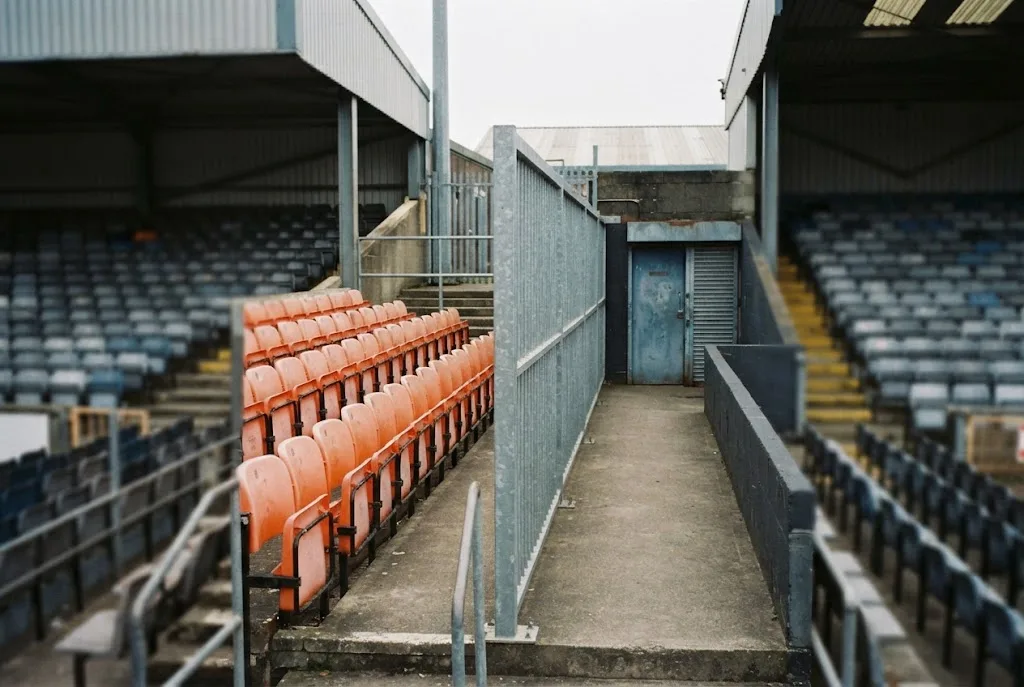
The away end is the one part of a football ground whose size is decided by rule rather than by demand, and almost everyone who has failed to get a ticket assumes the number was chosen by somebody being unhelpful. It was not. It is the output of a formula, a price cap and a loyalty ladder, and the three interact in ways that make a sold-out away end almost inevitable at the biggest fixtures.
The number itself
For league fixtures, the visiting club must be offered 3,000 seats or 10% of capacity, whichever is lower.
That phrasing is doing all the work. At a ground holding 25,000, the 10% figure applies and the allocation is 2,500. At a ground holding 60,000, the 10% figure would be 6,000 — but 3,000 is lower, so 3,000 it is. The allocation stops growing the moment a stadium passes 30,000.
The practical consequence is counter-intuitive. The larger the ground, the smaller the away end as a proportion of it. Supporters travelling to the biggest stadiums in the country are squeezed into the same 3,000 seats as those visiting a mid-sized one, in a building twice the size.
Why it is capped at all
There are two honest reasons and one that gets stated less often.
Safety and policing. Segregating two sets of supporters requires a physically separable block with its own access, its own stewarding and a route in and out that does not cross the home support. That constrains where an away end can be and how large it can grow.
Revenue. Away tickets in the league are capped at £30, a figure clubs agreed between themselves and have renewed since. Home season tickets are not. A club has an obvious financial preference for selling a seat at its own price rather than the capped one, and the allocation being a floor rather than a target reflects that.
The third reason is atmosphere, and it cuts both ways. A large, loud away section is what makes a fixture feel like an occasion, and some clubs value that. Others regard 3,000 visiting supporters as the maximum they wish to accommodate.
The loyalty ladder
Having established how many tickets exist, the harder question is who gets them.
Nearly every club runs a loyalty points system. Attendance earns credit; credit determines priority; tickets are released in descending bands. For an ordinary fixture the allocation reaches supporters fairly far down the ladder. For a popular one it can be exhausted in the top band alone, before general members have any opportunity at all.
This produces the complaint that surfaces every season: that away support is closed to newcomers. It is structurally true. A system that rewards past attendance necessarily favours those who have already been going, and there is no version of it that also gives a first-time traveller a realistic chance at a fixture where demand is four times supply.
The alternative — a ballot — spreads tickets more evenly and is markedly less popular with the supporters who travel every week.
Watching it instead
Which is the position most people are in, because 3,000 seats against a support of many thousands means the overwhelming majority of a club's travelling contingent watches from somewhere else.
That is the gap Totalsportek occupies. Rather than publishing a timetable and stopping there, it gathers what is actually going out for a given fixture into one view, across competitions that have no reason to appear together anywhere else. Totalsportek spans several sports rather than specialising, so it is a place to start rather than the final word on any one match, and where a fixture is carried by a broadcaster in your country, that broadcaster will give you the better picture.
Cup ties are a different animal
The rules change substantially once a fixture leaves the league.
Domestic cup competitions require a far larger share of the ground to be made available to the visiting club — a multiple of the league figure rather than a marginal increase. A cup tie can therefore carry several times the away support of a league fixture at the same stadium, against the same opponent, weeks apart.
This is why a cup draw away at a large club is treated as a genuine event rather than a scheduling problem. It is frequently the only realistic chance a supporter outside the top loyalty bands has of getting into that ground all season.
For the football-only view of which of those ties are on and when, the corresponding part of Totalsportek, Soccer Streams, narrows a multi-sport calendar down to the one sport, which on a crowded cup weekend is the difference between scanning a page and scrolling past four competitions you do not follow.
Worth checking the date before booking anything, because fixtures move after the list is published and away travel is what absorbs the cost.
What has actually changed, and what has not
The price cap is the meaningful reform of the last decade, and it worked: away travel in the league is measurably cheaper in real terms than it was before, at a time when almost nothing else about attending football is.
The allocation formula has not moved, and there is no serious pressure to move it. In 2026/27, as in every season since the cap was introduced, the constraint on away support is not what a ticket costs. It is that there are three thousand of them.