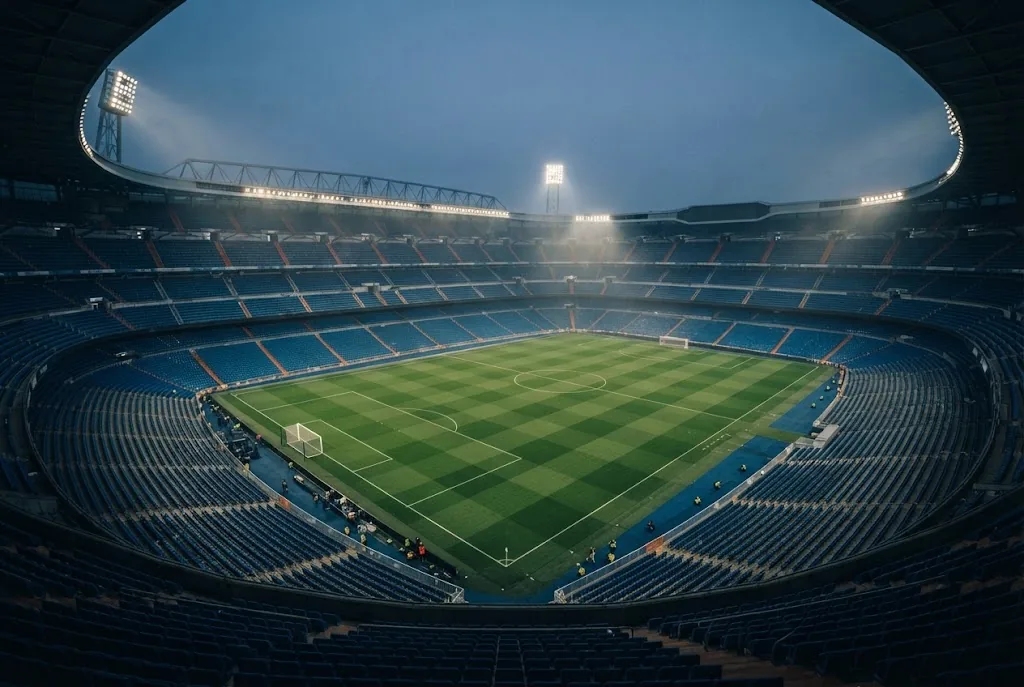
The Champions League draw used to be a piece of theatre with a very simple mechanism: pull a ball, place a club, repeat. Since the competition moved to a 36-club league phase, that is no longer possible, and the reason is arithmetic rather than showmanship.
Why it cannot be done by hand any more
Under the old group stage, a draw placed 32 clubs into eight groups of four. Each club needed three opponents, and the only real constraint was that clubs from the same country could not meet.
The league phase asks something much harder. Each of the 36 clubs needs eight different opponents, and those opponents must satisfy several conditions at once:
- Two opponents from each of the four seeding pots
- One of each pair at home, the other away
- No opponent from the club's own national association
- No more than two opponents from any single other association
Those conditions interact. Assigning an opponent to one club removes possibilities for several others, and a sequence of individually legal choices can arrive at a state where some club at the end of the process has no valid opponent left at all. A manual draw would have to either restart or fudge it, and both are unacceptable in a competition of this size.
What the software actually does
The ceremony is now a hybrid, and the distinction matters for anyone suspicious of the whole arrangement.
Physical balls still decide the order. A club is drawn from a pot by hand, exactly as before. That establishes which club is being assigned next.
The software then assigns that club's opponents, selecting at random from the set of pairings that keep a valid completion possible for every remaining club. It is not choosing a favourable draw or an unfavourable one. It is refusing to select the pairings that would paint the draw into a corner later.
This is a well-understood class of problem — constraint satisfaction with lookahead — and it is the same category of task as generating a domestic fixture list, which is also computer-generated for the same reason.
Why the pots exist
Seeding spreads quality so that the table is not decided by who drew whom.
Pots are built on the club coefficient, a rolling measure of a club's European results over recent seasons, with the reigning champion placed in Pot 1 regardless of its coefficient. Pot 1 holds the strongest, Pot 4 the weakest.
Because every club plays two opponents from every pot, every club faces a comparable spread: two of the strongest, two of the weakest, and four in between. The identities differ enormously, the shape does not.
This is also why the associated country ranking matters so much across a season, since it is what determines how many clubs each nation sends in the first place. The country coefficient tables are updated as results come in.
The complaint about the ceremony
Something genuine was lost, and it is worth naming rather than dismissing.
The old draw had suspense with a rhythm to it. A ball came out, and everyone watching immediately understood what it meant for their club. The tension built group by group over several minutes.
The new format compresses that. A club is drawn, eight opponents appear on a screen almost at once, and the emotional beat that used to arrive one opponent at a time now arrives in a block. It is more efficient and less dramatic, and people who valued the drama are not being unreasonable.
What has improved is fairness in a narrow but real sense. Under the old system, a draw could produce a genuinely brutal group and a genuinely soft one, and that difference frequently decided who progressed. The pot structure across eight fixtures smooths that considerably. Nobody now gets an easy passage because a ball came out in a helpful order.
What has not changed
Two things worth stating plainly, because both are regularly assumed otherwise.
The draw is not weighted toward producing marketable fixtures. The constraints are structural, and the randomness within them is real.
And the seeding does not protect the strongest clubs from each other. Two Pot 1 clubs can and do meet in the league phase, because every club takes two opponents from Pot 1 and the Pot 1 clubs are no exception to that rule.